In the last fortnight, there has been an interesting programme on ITV based around the comings and goings at Westminster Register Office. It had something for everyone - laughter, tears, pretty weddings, quick-and-cheap weddings that turned out to be filled with emotion after all, civil partnerships, talking heads, The Royal Baby... the lot. It was quite nicely observed, but it raised some interesting issues.
Clearly, the fundamental basis of civil registration of hatches, matches and dispatches is control. It is always useful to literally know where the bodies are buried and people are easier to track and social and moral rules easier to enforce if people can be pinned down at important points in their lives. At the most basic level, the three key points of life are birth, marriage and death, so that's a good place to start. Civil registration, as introduced by Queen Victoria on 1 July 1837, took over where the Church of England left off and regularised the position regarding marriages so that non-Church of England marriages could be recognised as long as a registrar was present.
The Victorian Era was a period of expansion of both Empire and the State - at least in part because an Empire is easier to run with a proper bureaucracy. Information is power and the more information was nailed down, the more control the state had. If you are looking for information about your ancestors you are far more likely to find it in an area which has been part of an Empire and retained the structures thereof, than in an area which has been passed from nominal ruler to ruler over a long period; each new ruling body tends to try to start again, which leaves the records in a terrible mess. Even the USA, which has a terrible fear of federal government holding all the information, keeps good records at state and county level, if you know where to look.
So, recording births, deaths and marriages was initially a governmental construct, but it is actually much more than that. All societies seek to recognise important social points in the lives of their inhabitants, and these began as social constructs which government or the church then became involved in. The recording of birth allows planning for the correct size of population - but also recognises the arrival of a new, tiny, human being and the formation of a new set of relationships between that child and others. Even if they are the youngest of 11 children, the new child will have relationships entirely of his or her own with everyone else, starting with their parents. Baptisms (and their recording) allow the formation of a new relationship between the child, her family and the wider church community, and the new civil naming ceremonies allow the same without a religious aspect. Binding the new child to their family and wider community is one of the most important things a family can do, providing the scaffolding upon which a life will later be built.
And what of marriage? Registration both at church and in the civil record made the marriage public and bound people together in the eyes of society, although until comparatively recently it was possible to achieve a de facto divorce by both partners agreeing to part, moving to opposite ends of the country and claiming to be widowed. The problem with bigamy, in the eyes of many, was not technically being married to two people, but when one partner did not agree to the parting and was abandoned, often with children to care for. Let us not forget that although a marriage can be clandestine, it cannot be completely secret - notices must be given, licences sought or banns read, and the church or registrar's office cannot be closed during the ceremony - any one must be able to attend (and object, if they see fit!). Marriage is about the public recognition of the formation of a new family. Even Scottish irregular marriages were based on the principles of mutual consent before witnesses, and this was why marriage at Gretna Green was popular - just over the border into Scotland, no parental consent was required providing the two parties were over 16 (prior to 1929 the age was 12 for girls and 14 for boys) and a declaration that the couple considered themselves married was enough. It often fell to the blacksmith to be the witness, because he was easy to locate and identify!
And finally, death. This is perhaps the most important recognition of them all - the closing of a life, however long or short, and the acceptance that the life had value. Many societies have ancestor-veneration at their heart, for it is only in the retelling of lives and the remembrance of former family members that their lives are recognised and celebrated. In the Series 10 episode of Who Do You Think You Are starring the actor Nitin Ganatra, there was an affecting moment when he had cause to finally register the death of one of his mother's infant sisters, many many years after she died. There was a palpable sense that the act of registration brought the lost child back into the family and acknowledged her as one of them and part of the wider family story. Later, when he added his own and his children's names to the local records in the city of Mathura in India, extending the family line to 10 generations the power is again in the recognition of the familial connection.
So the registration of the important points in people's lives are not just about control - they are about the marking of a liminal moment, a turning point where a family stands on the cusp of something new. Possibly not quite what the government intended in 1836-7, but vital nonetheless.
Monday, 24 February 2014

Monday, 10 February 2014
The Rolling English Road
I referred to this poem in my previous post Genealogy Blogging, and on further consideration it struck me that it is a good metaphor for my approach to family history. I find it can't be taken in a linear fashion - you have to jump from place to place, following hunches and lunches and places of work, looking at the local rather than the national, making educated guesses as to motivations and obfuscations. Also, I like Chesterton as a poet, and this poem particularly. My father introduced me to it when I was about 11 or 12, and it was the first time I realised Victorian poets could be funny not starchy (although the poem was written in 1913, I suspect Chesterton considered himself Victorian). Chesterton himself, of course, may be considered a "local lad", dying at his home in Beaconsfield in 1936.

Here, therefore, for your delight and delectation, is The Rolling English Road:
Before the Roman came to Rye or out to Severn strode,
The rolling English drunkard made the rolling English road.
A reeling road, a rolling road, that rambles round the shire,
And after him the parson ran, the sexton and the squire;
A merry road, a mazy road, and such as we did tread
The night we went to Birmingham by way of Beachy Head.
I knew no harm of Bonaparte and plenty of the Squire,
And for to fight the Frenchman I did not much desire;
But I did bash their baggonets because they came arrayed
To straighten out the crooked road an English drunkard made,
Where you and I went down the lane with ale-mugs in our hands,
The night we went to Glastonbury by way of Goodwin Sands.
His sins they were forgiven him; or why do flowers run
Behind him; and the hedges all strengthening in the sun?
The wild thing went from left to right and knew not which was which,
But the wild rose was above him when they found him in the ditch.
God pardon us, nor harden us; we did not see so clear
The night we went to Bannockburn by way of Brighton Pier.
My friends, we will not go again or ape an ancient rage,
Or stretch the folly of our youth to be the shame of age,
But walk with clearer eyes and ears this path that wandereth,
And see undrugged in evening light the decent inn of death;
For there is good news yet to hear and fine things to be seen,
Before we go to Paradise by way of Kensal Green.
G. K. Chesterton
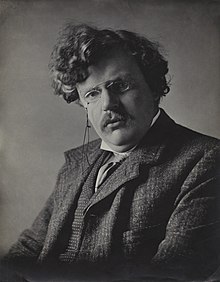
Gilbert Keith Chesterton, taken by E. H. Mills in 1909
Here, therefore, for your delight and delectation, is The Rolling English Road:
Before the Roman came to Rye or out to Severn strode,
The rolling English drunkard made the rolling English road.
A reeling road, a rolling road, that rambles round the shire,
And after him the parson ran, the sexton and the squire;
A merry road, a mazy road, and such as we did tread
The night we went to Birmingham by way of Beachy Head.
I knew no harm of Bonaparte and plenty of the Squire,
And for to fight the Frenchman I did not much desire;
But I did bash their baggonets because they came arrayed
To straighten out the crooked road an English drunkard made,
Where you and I went down the lane with ale-mugs in our hands,
The night we went to Glastonbury by way of Goodwin Sands.
His sins they were forgiven him; or why do flowers run
Behind him; and the hedges all strengthening in the sun?
The wild thing went from left to right and knew not which was which,
But the wild rose was above him when they found him in the ditch.
God pardon us, nor harden us; we did not see so clear
The night we went to Bannockburn by way of Brighton Pier.
My friends, we will not go again or ape an ancient rage,
Or stretch the folly of our youth to be the shame of age,
But walk with clearer eyes and ears this path that wandereth,
And see undrugged in evening light the decent inn of death;
For there is good news yet to hear and fine things to be seen,
Before we go to Paradise by way of Kensal Green.
G. K. Chesterton
Thursday, 6 February 2014
On Serendipity
Serendipity is a funny thing. The concept of benign fate, of fortuitous happenstance, of life and experience combining to bring someone to a new understanding or discovery by chance, but based upon existing experience, is in many ways alien to the usual understanding of 'fate'. People are usually more familiar with the fatalistic Anglo-Saxon concept of 'wyrd', from the Old English verb weorþan, "to become" (an ancestor of the modern English 'weird'), which implies a malevolent fate ultimately out to get you.
Seredipity, though, is a friendly thing; the intercession of the universe in one's daily life in a pleasant way, enabling the making of connections and the increase in human understanding. The term was reported coined by Horace Walpole in 1754, in response to a Persian traditional tale set in Serendip (now Sri Lanka), where things were repeatedly discovered by accident as an adjunct to the tale.
Within family history, there is a tendency to seek a reason for everything. What led your great-great-grandparents to meet? Were they part of the same church congregation? Did they work together? Were their families living on the same street, or did one lodge with a cousin or family friend? Often, there are answers of this kind to be found, and this is why connections can be made by mapping the family in geographical terms as well as laying out timelines. Sometimes, though, we must accept that serendipity was at play.
This morning, I had a seredipitous moment. It was a rare quiet morning for me - no meetings, no phone calls, no urgent emails to send or pressing need to bury myself in the records of 18th century Devon and Cornwall (which may well have been drier than 21st century Devon and Cornwall). I rewarded myself with a sneaky coffee in town. Because the cafe was busy, I shared a table with a stranger. We got to talking about nothing in particular, and it became apparent that she was also interested in social history. Suddenly, for the price of a cup of coffee and an almond croissant, I have a new acquaintance who shares my interest in family history and might be interested in sharing information. This is the sort of meeting that public record will not necessarily show, but can change a family story. My parents met on a bus - but they turned out to be working for the same company; my grandparents met when my grandfather whistled at a pretty girl in the street - but she turned out to be lodging with his cousin. These meetings may well have happened eventually through other means, (after all, we are only ever six degrees of separation from anyone) but this morning serendipity gave it all a little nudge. Benign intervention of the Universe indeed.
Genealogy blogging
Genealogy and blogging do not naturally go together. Genealogy is, perforce, something one does alone, sharing the results of research or new sources, but a running-commentary would be long-winded, slow and, dare I say it, very dull indeed, even for other enthusiasts. Blogging is more immediate, more stream-of-consciousness, more of a way to provide a snapshot of something swift and exciting.
So how to marry the two together? Sometimes, when researching, something occurs which is instant and exciting and needs to be shared (within the confines of not spreading other people's family trees all over the internet without their permission). Mostly, though, the long slow trawl through tiny, tiny, pieces of information (which is what genealogy really is) and the gradual building of a picture leads to a sudden understanding of how some aspect of society has changed (or not!) over the last few centuries, as modelled by one or several families.
This blog is unlikely to lead anyone to finding lost millions, or suddenly inheriting a private island. It might, though, lead to an appreciation of how or why your family did what it did; what drove them, what formed their attitudes and aptitudes, what happened that led to "the night they went to Birmingham by way of Beachy Head" (The Rolling English Road, G.K. Chesterton).
Alternatively, I might just write about things that seem interesting to me.
Subscribe to:
Posts (Atom)